Chinese Astronauts Return After 204 Days in Space Amid Station Emergency
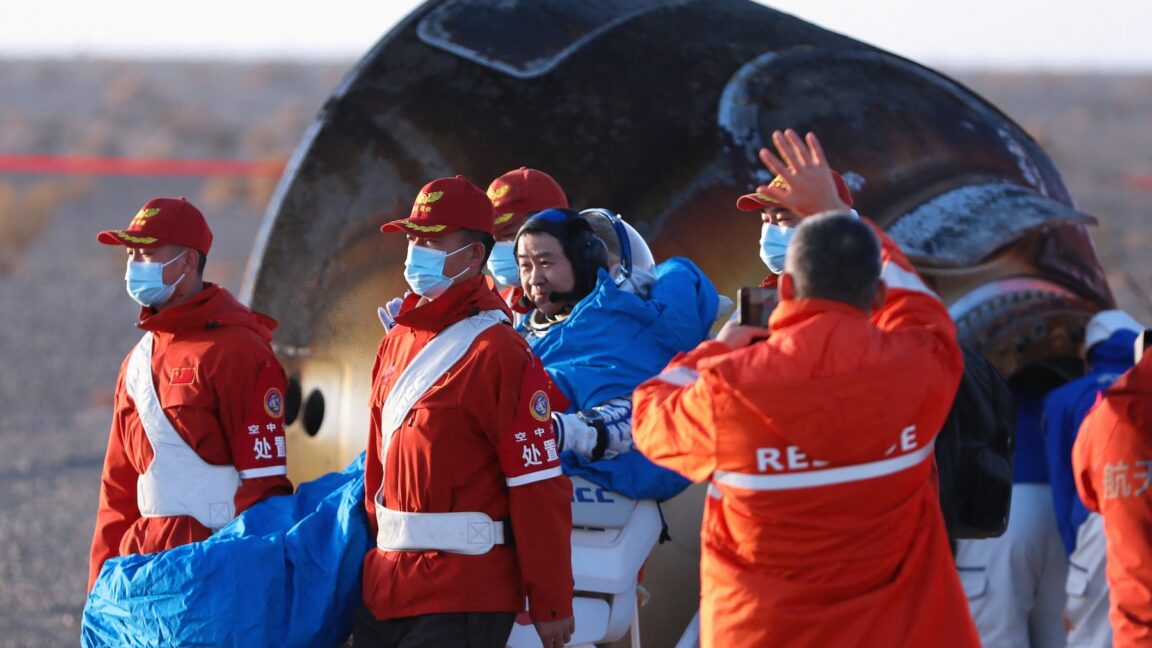
After spending over six months orbiting Earth, three Chinese astronauts safely returned to the planet, but their journey highlights ongoing challenges aboard China’s space station. The crew’s return was complicated by a critical issue: a damaged lifeboat, leaving the station with limited rescue options.
Commander Chen Dong, in his third space mission, along with rookies Chen Zhongrui and Wang Jie, touched down early Friday morning in the Gobi Desert. Their spacecraft, a Shenzhou capsule, deployed parachutes for a soft landing at the Dongfeng landing zone, near northwestern China’s remote plains.
Interesting:
- U s lawmakers raise alarms over flaws in artemis plan amid growing chinese space ambitions
- Russias next space station a bold move rooted in national pride
- Blue origins breakthrough from dream to reality in space launches
- Why electric vehicles outperform gas cars in climate impact after just two years
- Blue origin achieves historic rocket landing signaling a new era in space launches
Last week, Chinese space officials revealed damage to one of the two Shenzhou return modules docked at Tiangong. This incident prompted a sudden alteration in the station’s operational plans. The China Manned Space Agency, overseen by the military, announced that the crew’s departure would be delayed or complicated due to the compromised lifeboat, raising concerns about station safety and rescue readiness.
According to space safety experts, such damage underscores the importance of robust emergency systems in crewed space stations. While China’s space program has achieved significant milestones, this incident raises questions about long-term crew safety and contingency planning in orbit.