Eid ul Fitr 2026 date declared for USA and most of North America
The date of Eid ul Fitr 2026 has been declared for the USA and most of North America, based on advance calculations.
The Fiqh Council of North America has announced that Eid ul Fitr 2026 will be on Friday, March 20. It could still vary across the continent as a number of Islamic organisations in America make their own rulings on when Eid will be.
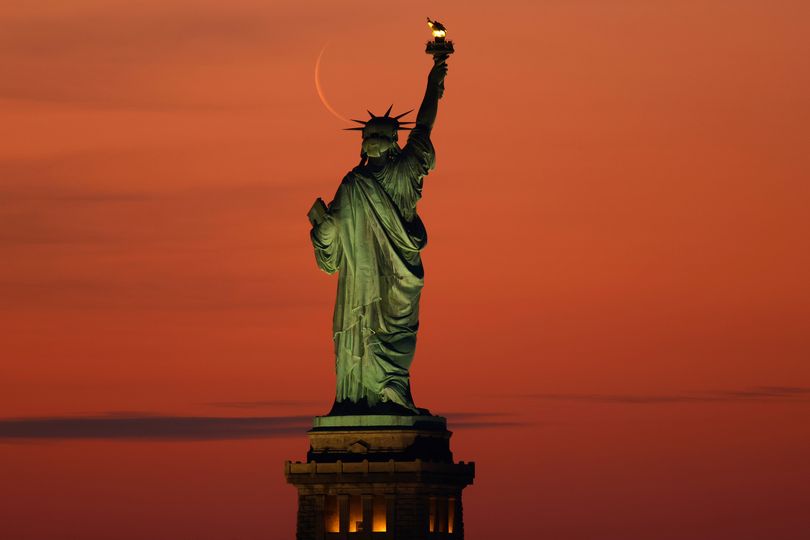
The council based its decision on the new moon being born on Thursday, March 19. Later that day, the first faint crescent is expected to be visible across much of North America, with calculations of ‘easy visibility’ confirmed for New York on the east coast and Los Angeles on the west coast.
READ MORE:
The FCNA says it “recognises astronomical calculation as an acceptable method for determining the beginning of lunar months including the months of Ramadan and Shawwal.”
It uses the criteria set out by Dr Yusuf Al-Qaradawi, Head of European Council for Fatwa and Research (ECFR) in Dublin, which are that “somewhere on the globe, at the sunset, the elongation should be at least 8 degrees and moon should be at least 5 degrees above horizon.”
If these conditions are met, then it is certain that the moon is above the horizon and will be visible somewhere. The new lunar month – in this case Shawwal, which begins with the Eid festivities – would then start the next day. Otherwise it will start on the day after.
The FCNA ruled: “The Astronomical New Moon is on Thursday, March 19, 2026 at 1:23 Universal Time. On that day, the elongation is more than 8 degrees and moon is more than 5 degrees above the sun everywhere in North America. Hence first day of Shawwal is on Friday, March 20, 2026.”
Shawwal begins with the Eid ul Fitr 2026 festivities on its first day. They can last up to three days in all.
UK astronomers at the Royal Observatory, Greenwich, London, said that on March 19 “easy sightings” of the crescent with the naked eye should be possible from most of North America, except north-east Canada.
Those in central America will be able to spot the moon as long as the skies are clear, while people in northern parts of South America may need to use a telescope to see it. For the southern half of South America, the moon is not expected to be visible at all until the next day.