John Ivison: Europe lets Carney lead on poking the Trump bear
President Donald Trump’s late-night musings about Venezuela potentially becoming the 51st state were likely well received in the Prime Minister’s Office.
It suggests that Mark Carney’s speech in Davos — widely viewed as standing up to the bully president — has persuaded Trump to move on and find an easier target than Canada or Greenland.
That may be temporary, of course, given the president’s mercurial nature.
All the signs are that as Canada, the U.S. and Mexico move towards the business end of new trade negotiations, Trump will impose fresh sectoral tariffs, using the national security provision in the Trade Expansion Act. (The administration has conducted nine industry investigations — completed or pending — in sectors like semiconductors, pharmaceuticals, commercial aircraft, drones and robotics).
The president is under pressure from Congress and American voters, neither of whom likes his tariffs. But he is a protectionist from the tips of his Florsheim black Oxfords to the top of his combover. More tariffs are coming.
U.S. President Donald Trump speaks during a meeting with German Chancellor Friedrich Merz in the Oval Office of the White House in Washington, DC on March 3, 2026.
Yet, he appears to have been chastened by the solidarity Carney has helped induce among European leaders. He hasn’t talked about annexing Greenland in nearly two months and while he recently referred to Carney as “governor,” he hasn’t been explicit about his 51st state ambitions vis-à-vis Canada for a similar period.
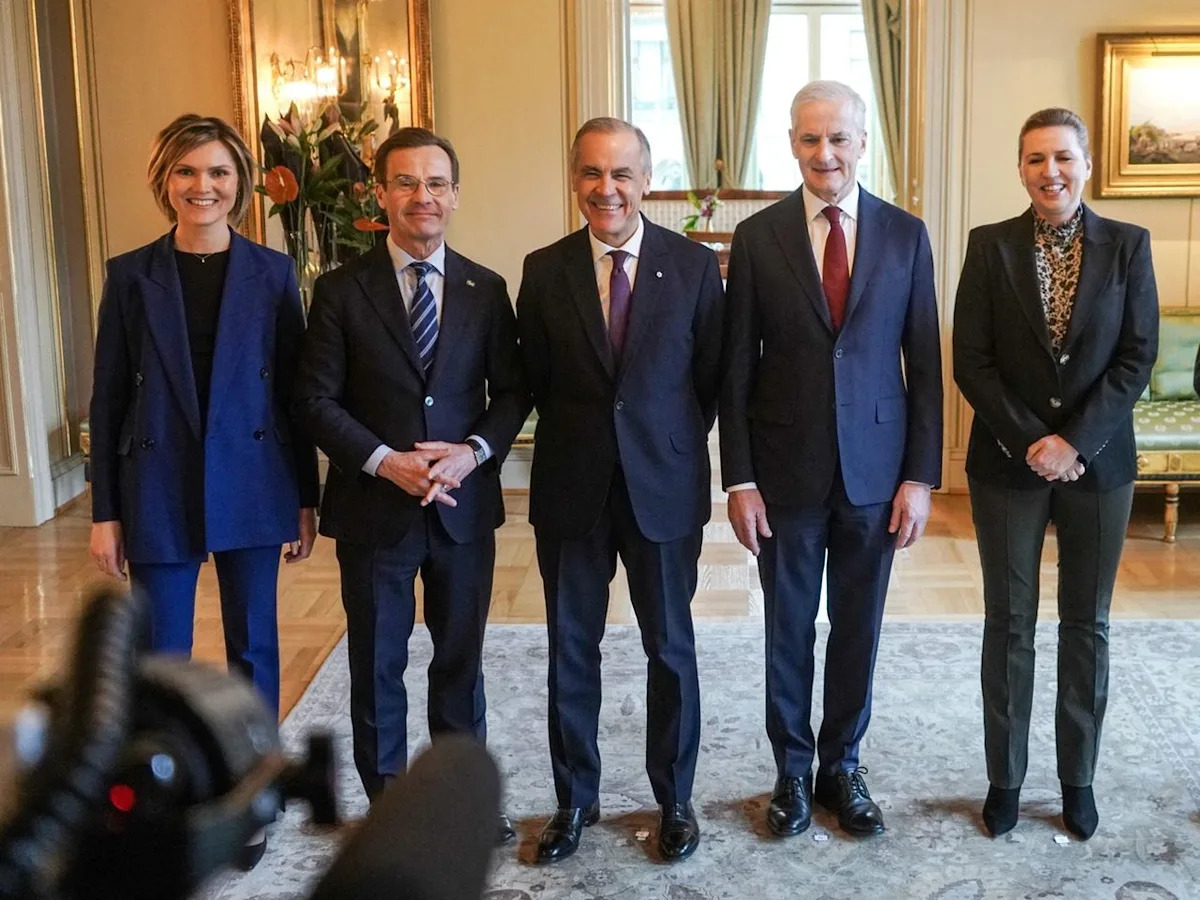
In a press conference with the prime ministers of Norway, Sweden, Finland, Denmark and Iceland on Sunday, there was praise for Carney’s leadership, which Iceland’s Kristrun Frostadottir said has “filled a void.”
In his January speech to the World Economic Forum in Davos, Carney said Canada stood firmly with Greenland and Denmark, and that middle powers must act together “because if you are not at the table, you are on the menu.”
VIDEO
Denmark’s Mette Frederiksen said he has won a lot of supporters in the Nordic countries. “We have never experienced anything like this … It showed leadership on how democracies can work together,” she said, in the face of “totally unacceptable pressure from the U.S. president.”
Carney was asked whether the threat to (Canadian and Danish) sovereignty is over.
He said Canada and its European allies were clear about the fundamental principles of territorial integrity and that “has created space which always should have been there.” In other words, they collectively resisted Trump’s attempt to wedgie the class nerd.
These informal alliances are not going to change the world: Iceland has a smaller population than London, Ont.
But Carney has galvanized other, more formal groups of middle powers, such as the exploratory talks taking place between the European Union and the 12-member Trans-Pacific Partnership (of which Canada is one) about forming a new trading bloc. This is an idea he has pushed for some time and publicized last fall.
All of this may yet rebound on the prime minister. All Canadians may yet pay the price for poking the bear.
But at this moment in its history, Canada is commanding more attention on the world stage than any time in the last 40 years.
Canada’s declension became the stuff of satire. “You needn’t worry about the Canadians … They always look surprised they’ve been invited,” said one British foreign policy adviser in the 2009 political lampoon movie, In the Loop.
Justin Trudeau proclaimed early in his mandate: “On behalf of 35 million Canadians, we’re back.”
But his preaching on “progressive values” upset allies as well as adversaries. The lack of regard was apparent in Canada’s failure to win a UN Security Council seat in 2020, after a similar failure under Stephen Harper in 2010.
Harper upset many partners, and much of his own foreign policy establishment, by supporting Israel through thick and thin, something his critics accused him of doing to win Jewish votes at home. He was respected on the international stage, hosting the G8/G20 in 2010, as well as honouring Canada’s commitments in Afghanistan, at significant human cost. But he was always a politician more than a statesman.
Stephen Harper gestures to a crowd of supporters during a victory rally in Calgary, on Jan. 24, 2006.
Readers will no doubt prove me wrong with their own examples of consequential foreign policy moments (perhaps Jean Chrétien saying no to participating in the Iraq war). But the last time Canada’s voice held such sway was, arguably, under Brian Mulroney on apartheid.
The Progressive Conservative prime minister secured agreement among Commonwealth leaders to impose limited economic sanctions against South Africa and, in his speech at the UN General Assembly in 1985, Mulroney pledged that if fundamental changes did not follow, Canada would sever relations with South Africa completely.
In his personal journal for July 23, 1986, Mulroney noted that then U.K. prime minister “Margaret (Thatcher) advanced her view that sanctions were ‘immoral.’ I strongly objected … (and) indicated that if she persisted in her view, she could well … forfeit the position of moral leadership that Great Britain exercises in the Commonwealth. She appeared shaken by the firmness of the Canadian position. I almost had to raise my voice strongly at one point to interrupt her constant stream of argument.”
Mulroney also faced opposition from U.S. president Ronald Reagan, who vetoed legislation in 1986 to impose new sanctions on Pretoria. Mulroney noted that both Thatcher and Reagan considered Nelson Mandela a communist.
However, by the late 1980s, South Africa’s economy was being squeezed by sanctions and it was clear the changes that Mulroney advocated were going to prevail.
It’s impossible to know why both Carney’s Davos speech and Mulroney’s at the UN resonated so loudly, but there was commonality in their message: You can’t let the bullies win.
National Post
- FIRST READING: Carney was elected to save the economy. It’s only gotten worse
- John Ivison: The election temptation of Mark Carney